




How to Resize a Football Jersey: Fast & Easy Methods
Want to quickly change a small jersey, but also afraid of damaging the synthetic fabric or hot offset printing team logo? In fact, the solution is very simple: if you want to emergency, with double-sided cloth with tape to spend 5 minutes to get the hem; if you want to permanently slim, take a round needle slightly sew the side seam on the line.
I believe many people have had this experience: finally found 1 a super handsome retro jersey, or picked up 1 pieces at a discount, and it turned out to be as big as a parachute. At this time, don’t rush to find an expensive tailor, and don’t use hot water to scald this “suicidal” shrinkage method. As long as I give you a table, you can handle it yourself in less than 20 minutes.
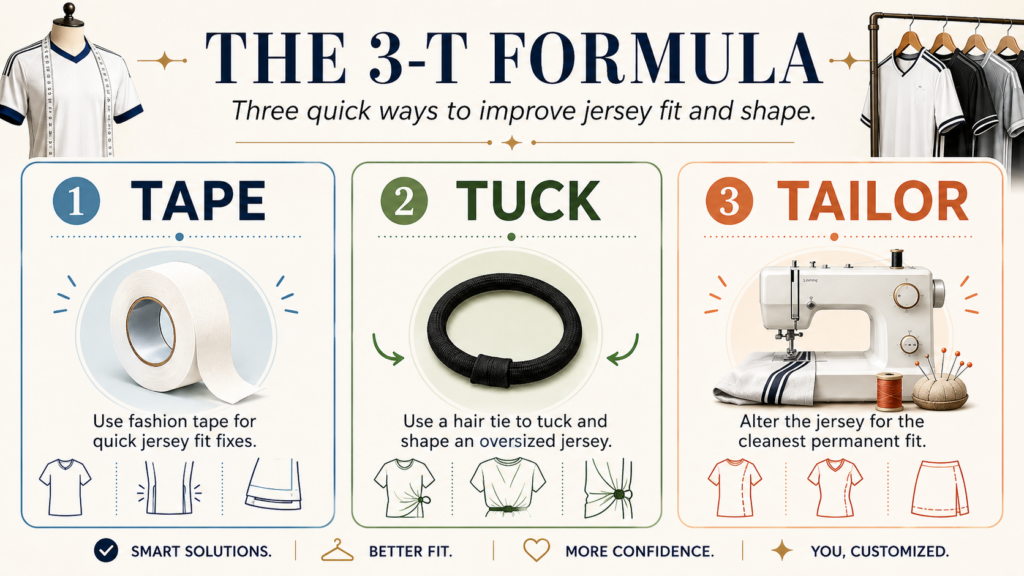
My “3-T” Rule Of Changing Clothes
As a 10-year veteran of changing sports jerseys, I ‘ve come up with a “silly” framework for dealing with polyester fabrics. This “3-T” rule can accurately match the most suitable modification scheme according to your own hands-on ability.
- Tape (Tape-Novice Level): Shorten the garment length purely by ironing-free hem tape, without the need for needle and thread.
- Tuck (Hanging-Chaozhou People): Skillfully used 1 hidden rubber bands to change the jersey into a short Crop top suitable for daily going out of the street without leaving any permanent trace.
- Tailor (True Cut-In Class): Use a pin and sewing machine to tighten the side seams and permanently narrow the bust and waist.
How To Shorten The Jersey (Length Adjustment)
As we all know, jerseys are often designed to be extra long in order to tuck them into shorts during games. Changing the short hem requires some skill, otherwise it is easy to destroy the original version of the clothes, especially when encountering the modern “dovetail” hem with short front and long back.
Method 1: non-ironing crimping tape (no sewing)
If you don’t have a sewing machine, hemming tape is definitely the safest way to shorten the cloth. But remember, don’t use the kind of tape that needs to be heated by an electric iron near the sponsor logo. The high temperature of the iron will instantly destroy those polyurethane offset prints.
- Turn the jersey over and lay it flat on the table.
- Fold the hem up to the length you want and secure it with a pin.
- Put the double-sided cloth into the crease with tape (be sure to buy the one marked for synthetic fibers).
- Press firmly along the crease with your fingers. Finally, press a thick book for 10 minutes to make the adhesive stick completely.
Method 2: clipping plus suture (once and for all)
If you want to permanently shorten your jersey, moving scissors and sewing machines are the only way out. However, you have to close the edge again, otherwise the polyester fabric will definitely unthread after wearing it for a long time.
- Put on the jersey and draw the perfect length you want with tailor’s chalk. Remember to set aside about 1 inch (2.5cm) more for the seam.
- Take a sharp cloth cut and cut it directly across the bottom edge.
- Fold the extra 1 inches in, secure with a pin, and then run a 1 circle of “Z” stitch along the edge. Why use Z-shaped? Because the sports fabric is elastic, this kind of line can follow the fabric stretch, the line is not easy to break.

How To Change The Jersey To Thin (Width Adjustment)
Put both sides 1 and 1 a large retro jersey from the 1990 s can be turned into a modern slim fit immediately. The most accurate way to change the width at home is the “pinch and don’t (Pinch and Pin)” method.
- First of all, you have to wear the jersey upside down so that the seams face out so that you can mark exactly where it is loose.
- Pinch the excess fabric: Stand in front of the mirror and pinch the excess fabric along your ribs and waist. Pay attention to keep the left and right sides symmetrical.
- Don’t Pin: Pin a row of pins straight along the line you pinched out. When approaching the armpit, the direction of the pin should be skimmed out a little so that the new stitches can naturally transition to the original sleeve stitches.
- Stitch new stitches: Take off your jersey, step on the sewing machine, and sew all the way down the needle and thread that you just did.
- Trim the excess: leave about half an inch of fabric outside the new stitching and cut off the rest.
The Iron Law Of “Anti-Melting”: The Clothes-Changing Pit That Experts Are Avoiding.
If you treat sports equipment as an ordinary cotton T-shirt, it will take minutes to destroy the 1 150-knife player’s version of the jersey. The jersey is very delicate and must be taken special care.
First, never try to shrink with high temperature.
Polyester doesn’t shrink at all in hot water. If you whimsical go to boil the jersey, or throw it into a high-temperature dryer, the result will only be that the fabric fibers are severely deformed and the sponsor logo, player seal and team logo are completely scalded. Those offset prints will stick together in a sticky way, and the whole garment will be scrapped directly.
Second, remember to change into a round head (jersey special) needle.
Ordinary universal machine needles will roughly pierced through the fabric, leaving holes. The round needle (70/10 or 80/12 gauge) is cleverly designed to slide through the gaps between the polyester mesh yarns. If the head iron does not use ordinary needles, it is not only easy to jump wires, but also possible to hook wires, leaving ugly silk marks on the front of the jersey.
Measured Contrast: Tape Vs Sewing Machine, Who Is More Resistant?
In order to see which DIY shortening method is more reliable, I took two identical 100 percent recycled polyester jerseys (made of Dri-FIT similar to modern Nike) and tested them for a month. I want to see who can live to the end under the toss of weekly wearing and cold machine washing.
| Alteration Method | Time to Apply | Tool Required | Durability after 10 Washes | Best For |
| Double-Sided Hem Tape | 5 Minutes | Fabric Tape | Edges began peeling at Wash 4 | Quick fashion fixes, matchday emergencies |
| Machine Zig-Zag Stitch | 20 Minutes | Sewing Machine (Ballpoint Needle) | 100% Intact, zero fraying | Permanent wardrobe integration, active playing |
The result is obvious: if you just want to go to the bar to watch the ball or go to the stadium to make a temporary dented shape, the tape is definitely a good way to save trouble. But if you want to do it once and for all, honestly spending 20 minutes on the sewing machine is the ultimate destination of sportswear.
Frequently Asked Questions (FAQ)
Q: Can I take my jersey to an ordinary tailor to change it?
Answer: Totally. Professional tailors can fix the jersey. The price is between 15 and 30 US dollars, depending on whether you shorten it, narrow the waist or narrow the cuffs. However, it is best to ask 1 mouths specifically to see if they have any experience in handling high-stretch sports synthetic fabrics.
Q: How can you make your jersey smaller if you can’t sew?
A: You can use some small skills to wear, such as the “hair band plug method”. Gather up the excess fabric on the back or side of the jersey, tie a small pull with 1 elastic hair loops, and then turn the knot into the inside of the shirt to hide it. This instantly creates the 1 kind of slim-fit short visual effect.
Q: Can the player version (Authentic) jersey be changed?
A: It can be changed, but the side of this kind of top jersey usually has laser ventilation holes and adhesive joints. You have to bypass these parts. Generally speaking, if you want to change the side seams of this kind of clothes, you have to sacrifice its carefully designed breathable mesh area, which must be prepared psychologically.
Q: Does washing the jersey in hot water shrink it?
Answer: It is impossible. Football uniforms are generally made of synthetic materials such as polyester or spandex, which do not shrink at all. The high temperature will not only fail to achieve the goal, but will destroy the elasticity of the fabric, and will make the seal and the team logo fall off directly.
Q: How to shorten the sleeves of the jersey?
Answer: Fold the cuff in to the length you want, and then walk a straight line around the circle to stitch it. Here’s a trick: pull the fabric a little as it passes through the sewing machine so that the new cuffs are malleable and won’t jam your biceps.