




Design Your Own Football Jersey: Customize Like a Pro
Want to really figure out how to design your own football uniform? Listen to my 1 advice, as soon as possible to abandon those simple “silly drag generators” on the Internet, go straight to the real clothing engineering-to understand the pure vector graphics, CMYK color configuration and sublimation templates. If you are preparing a jersey for the weekend league or the school team, don’t just find a JPEG logo and send it to the custom website. The finished product is absolutely blurred in pixels, covered in offset printing, and stuffy to wear.
Many amateur team leaders do not realize a core problem: custom jerseys are actually making a perfect match between the chemical composition of the ink and the breathability of the fabric. You are not simply “picking colors”, you are building professional sports performance equipment. Next, I will give you a thorough dismantling of the underlying structure used by professional jersey designers, revealing the hidden fabric black technology that determines players’ discomfort, and taking stock of the fatal typesetting mistakes that destroy amateur uniforms in minutes.
Exclusive Teardown: V.F.P. Jersey Design Architecture
After professional sportswear manufacturers get the design draft, they will use a set of architecture called “V.F.P.” (Vector vector, Fabric, Placement position) to evaluate the feasibility. I sum up this system to help you fill in the big hole between the “concept map on the screen” and the “actual combat jersey.
The V.F.P. Design Architecture
| V – Vector Foundation (Requires .SVG/.AI files, no pixels) | F – Fabric Chemistry (Sublimation vs Vinyl/Heat Press) | P – Placement Rules (Collar clearance, chest sponsor scaling, number visibility) |
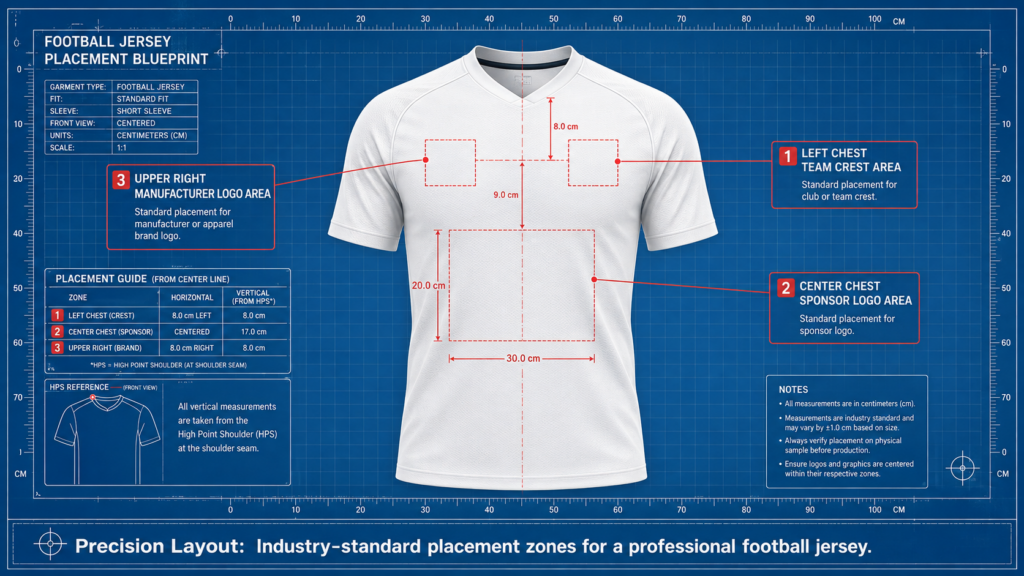
| Required Format: Must use Adobe Illustrator (.AI) or .SVG files for all crests, sponsor logos, and numbers. The Mechanism: Utilizes mathematical formulas to ensure designs remain razor-sharp at any physical scale, from tiny socks to an XXL chest. What to Avoid: Raster files (PNGs or JPEGs) are strictly prohibited, as they cause violent pixelation and blurred edges when scaled up to real-world factory proportions. | Recommended Method: Dye Sublimation is required over traditional Heat Press or Plastisol screen printing. The Mechanism: Sublimation turns colored ink into a gas that physically bonds with polyester fibers at a molecular level. The Result: The jersey retains a feather-light athletic feel and remains 100% breathable. Colors are permanent and will never crack or peel, even after heavy washing. | Dynamic Scaling: Design placement must be properly scaled across all sizes (Youth Small to XXL) to avoid a disjointed appearance. Crest Positioning: Must sit exactly over the left pectoral muscle, typically 3 to 4 inches down from the collarbone. Regulation Visibility: Back numbers must measure exactly 10 inches tall (per adult FIFA regulations), with precise vertical clearance from the nameplate to ensure clear visibility for referees. |
V: Vector (Vector Base)-Customized Lifeblood
Your design file directly locks the final print cap of the jersey. When preparing design materials, the team logo, sponsor Logo and player back number all have to use vector graphics (that is, Adobe Illustrator generated. AI or. SVG files). The principle of vector diagram is to rely on mathematical formulas to describe shapes. What does that mean? It means that whether your team logo is printed on a small sock or covered with 1 XXL jerseys on the chest, the edges are as sharp as ever. If you dare to hand in a bitmap like PNG or JPEG, the factory 1 enlarge it to the real size, and the edge of the pattern will immediately paste you into a full-screen mosaic.
F: Fabric (Fabric Chemistry)-Look For Sublimation
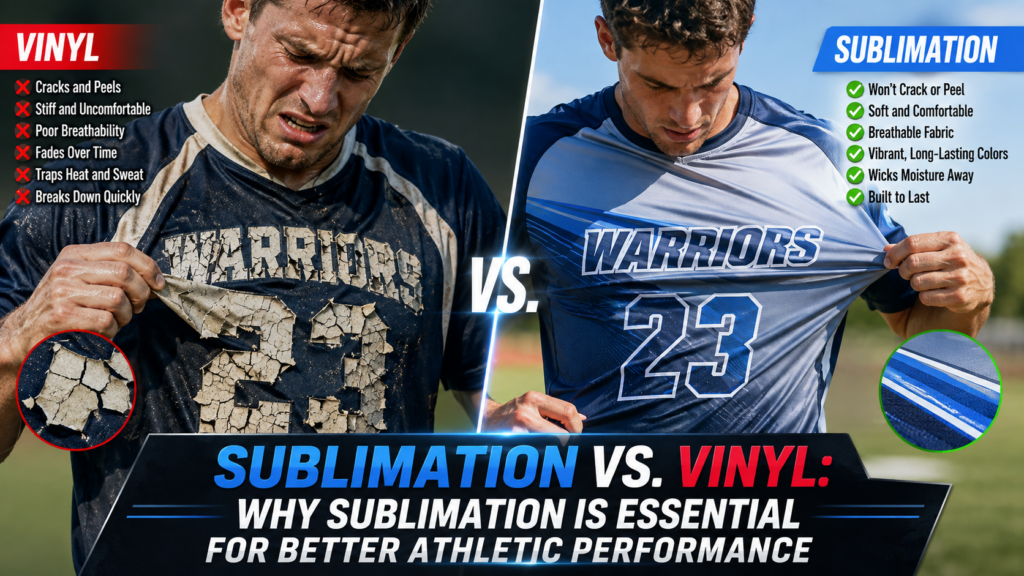
How to print the printing directly determines how heavy and breathable the clothes are. If you want to really play with jersey customization, please be sure to specify the “Dye Sublimation” process instead of traditional hot stamping film or thermosetting glue printing. Thermal sublimation technology can make the color ink vaporization, in the molecular level directly into the polyester fiber. The advantage of doing so is that the fabric retains 100% of the ventilation holes. No matter how violent you machine wash, the color will not crack or fall off. The whole dress is as light as nothing on the body and has a very sporty feeling.
P: Placement (Position Scaling)
A typesetting that looks very comfortable on the M-code template must be very strange if it is printed on XXL code or children’s clothing size. Professional customization is about “scaling”. The badge on the chest must be placed precisely on the left pectoral muscle, usually 3 to 4 inches below the clavicle. The number on the back, according to FIFA (FIFA) rules for adult players, has to be tightly stuck at 10 inches in height, while keeping a fixed vertical distance from the player’s name so that the referee can see it at a glance on the court.
Real rollover case: “sweat steamer” tragedy
If you don’t take the printing process seriously, you’ll suffer a lot when you get to the court.
A while ago, there was an amateur league. A new army designed an extremely attractive jersey with 1 huge black sponsor Logo on its chest. In order to dig some budget, the team manager did not choose heat sublimation, but used heat transfer lettering film (HTV). The result was good, and the solid vinyl film was like a thick and airtight plastic sheet that stuck to the outside of the player’s lungs and sternum. Playing in the summer at 90 degrees Fahrenheit (about 32 degrees Celsius), this layer of adhesive film covers all the heat in the clothes, and sweat can’t be discharged at all. Several players’ core body temperatures soared, and a 3 midfielder was carried off with severe heat stroke.
By the second week, we helped them redo the whole outfit with a 100 percent sublimation process. The ink directly ate the moisture-wicking mesh fabric without increasing the physical thickness. That “sweat steamer” miraculously disappeared. This fully proves that in jersey customization, material science and visual aesthetics are absolutely equally important.
A professional designer’s guide to avoiding the pit
The most easy mistake for amateur novices is to throw all the wrong design drafts to the manufacturers and watch the funds go down the drain. Before the next factory goes into production, please knock the following two iron laws to ensure that what you make is as you wish.
Avoid Pit 1:RGB Screen Color Scam
Don’t use RGB color mode to draw the team logo. The computer screen emits light through red (R), green (G), and blue (B) pixels, which can show a particularly bright-eyed, even neon effect, but the physical printer in reality cannot print this color at all. The manufacturer’s machine uses cyan (C), magenta (M), yellow (Y) and black (K) four-color ink to dye the fabric. If you send an RGB fluorescent green drawing in the past, the machine 1 automatically convert to CMYK, and the result is definitely 1 dark, gray, muddy olive green jersey. Remember, when you click on the first 1 of the design software, you have to set the color space to CMYK, so as to ensure that the color WYSIWYG is what you get.
Pit Avoidance Point 2: Completely Ignore The Neckline “Bleeding Position”
Arrange the patterns too close to the seams and the batch is basically useless. When the factory cuts and sews the printed fabric into jerseys, about 0.5 inches of fabric (known in the industry as bleeding and white space) must be “eaten” off at each seam. If your team logo is too close to your armpit or V-neck, the sewing machine will chop the logo with one stitch. Take the advice, all key logos, numbers, and sponsor text must be at least 2 inches (about 5 cm) away from any cut lines or neckline seams.
FAQ (everyone is asking)
How To Design Your Own Football Uniform From Scratch?
If you start from scratch, the process is as follows: first draw a sketch on paper to find inspiration, then switch to vector software such as Adobe Illustrator to draw the team logo and sponsor logo, and then apply these vector images to the manufacturer template in CMYK mode. Finally, the Tech Pack (Technical Pack) with all the details was sent to the sportswear manufacturers, and they were instructed to use the sublimation process to print it.
How To Customize The Jersey To Ensure The Print Is Safe And The Glue Does Not Fall Off?
If you can’t remove the glue, you have to completely avoid heat transfer film (HTV) and thermosetting paste printing. You have to explicitly ask the manufacturer to use “sublimation”. Sublimation penetrates the dye directly into the fabric fibers, rather than applying a thick plastic film to the surface, so no matter how the clothes are worn or washed, the pattern will never crack, peel or fade.
What Software Is Best Used To Design Football Clothes?
Adobe Illustrator is the industry standard because it can generate vector graphics (.AI,. EPS,. SVG formats) that are infinitely enlarged without pasting. CorelDRAW is also a very reliable spare tire. But remember, when making the actual Logo source file, never touch Photoshop bitmap-based software, not to mention those fancy mobile phone App, which is absolutely mosaic.
How To Give The Whole Team Uniform Custom Jersey?
If it is customized by the whole team, you need to organize a detailed “roster list” and write down the name, back number and their specific clothing size (S, M, L, XL) of each player one by one. Give this form to the mass manufacturer along with that unique vector design master file, and the manufacturer will naturally scale the pattern perfectly according to different sizes.
How To Make Custom Jersey More Breathable?
In order to keep the breathability, the fabric has to choose the kind of 100 polyester mesh cloth (gram weight is about 140-160 GSM) that absorbs moisture and wicks, and the process is hard to bite the heat and sublimation. If you make that kind of heavy embroidery (such as twill patch) or large-area adhesive patch, the ventilation holes of the fabric will be physically blocked, and the result will be that the body temperature and sweat will be stuffed in the clothes.
Can I Use The Logo Of Those Famous Brands When Customizing Jerseys?
Absolutely not. If there is no written authorization in black and white, the use of Nike (Nike), Adidas (Adidas) or the reality of those real enterprises (such as Emirates, Spotify) Logo, are all violations of trademark rights. Regular and reliable custom manufacturers will not accept such illegal lists. You must design your own original logo and use an original or licensed sponsor’s logo.