




What Material Are Rugby Jerseys Made Of
Modern rugby jerseys are usually polyester-based, with pure polyester and spandex blends. Pure cotton or cotton-polyester blends are also used in traditional styles and everyday casual styles. To answer “what material is used for rugby jerseys”, one must first look at the purpose of wearing them. one cannot treat all products called jerseys as the same fabric.
Which material to choose depends mainly on whether the dress is used for continuous running, contact and confrontation, or for watching matches and daily wear. The former needs to check the performance, activity space and seam strength after sweating. The latter can pay more attention to cotton touch, thick degree and loose version.
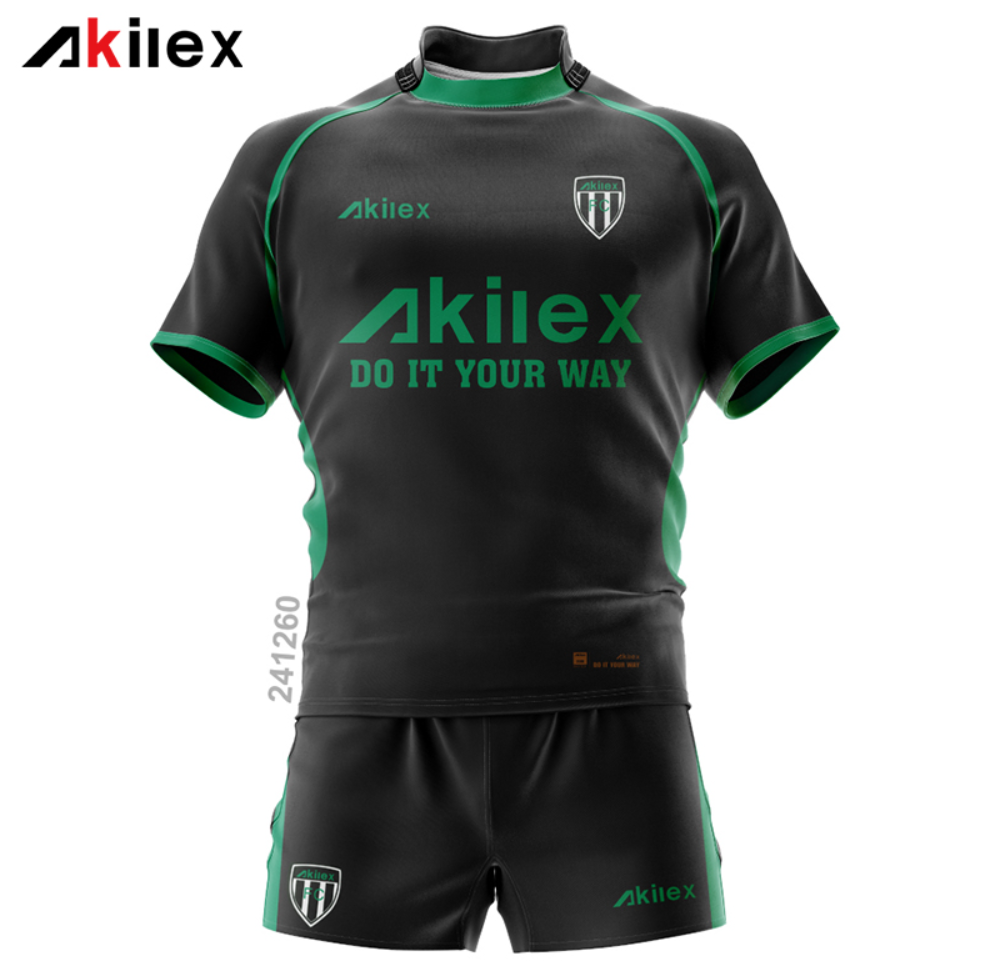
The Match Jerseys Are Primarily Made Of Polyester, With Some Spandex Blended In.
Polyester is the common name for polyester fiber. Modern game jerseys are mostly made of it, but not all games are pure polyester.
For example, Macron’s official rugby catalogue includes both match jerseys using 100 percent recycled polyester and match jerseys using 92 percent recycled polyester and 8 percent spandex. These products show that both formulas can be used for competition, but it cannot be concluded that the competition jerseys have a uniform material ratio.
The main difference between the two is the elastic design. The addition of spandex helps the fabric to restore its original shape after stretching, and also facilitates the use of close-fitting tailoring. Pure polyester fabric is also possible through the knitting structure to obtain a certain degree of extensibility, therefore, does not contain spandex does not mean that there is no elasticity.
If you want to choose a close-fitting competition, you can try on polyester and spandex blended styles first, but you don’t have to just stare at spandex content. Whether to limit the action when stretching, whether to recover after loosening, and whether the size is appropriate, is more useful than looking at the percentage of ingredients alone.
“Recycled polyester” mainly indicates the source of raw materials, and it still belongs to polyester. It is impossible to judge whether the jersey is more breathable, more durable, or more suitable for competition based on 2 word “regeneration” alone. These performances have to be checked separately.
Traditional Casual Styles Also Use Cotton And Cotton-Polyester Blends.
Traditional style jerseys with lapels, horizontal stripes, long sleeves, not necessarily using modern game materials.
A loose-fitting long-sleeved jersey from Canterbury is labeled as 60% cotton and 40% polyester, with a fabric weight of 350 g/m²; another traditionally styled Rugby Jersey is labeled as pure cotton. These specific styles indicate that cotton and cotton-polyester blends are still used in this type of jersey, but these formulations do not represent all jerseys.
A practical difference between cotton and polyester is the performance of sweat. Cotton absorbs and retains moisture easily; a properly designed polyester sports fabric allows moisture to pass along the fabric and dry faster. However, containing polyester does not guarantee that the garment has a good moisture conductive effect.
If it is mainly used for watching games, commuting or daily wear, cotton or cotton polyester blends are reasonable options, and there is no need to exclude them all for the sake of “competition feeling. If it is used in the scene of heavy sweating and continuous training, it is necessary to pay more attention to the skin feeling and dry performance after sweating. It cannot be decided only by touching softness when dry.
The fan edition isn’t necessarily made of cotton either. The product name can help to understand the positioning, and the specific materials still need to see the composition description of the corresponding model number.
Even With The Same Ingredients, Performance May Still Vary.
The material label can tell you which fibers are used, but it can’t tell you exactly how the jersey will look.
Even if the two fabrics are marked with pure polyester, they may have different air permeability and skin feeling due to different thickness, knitting structure, mesh distribution and finishing methods. Similarly, the inclusion of spandex only indicates the addition of elastic fibers and does not directly prove that the whole garment is pull-resistant.
| Information Provided | What It Can Establish | What Still Needs Checking |
|---|---|---|
| Fibre composition and percentages | Which fibres the fabric contains | Breathability, moisture transport, and drying performance |
| Fabric weight | Weight per unit area | Overall durability and suitability for hot conditions |
| Elastane content | The composition includes an elastic fibre | Actual stretch, recovery, and freedom of movement |
| Seam and construction details | Where particular construction methods are used | Performance during contact play and repeated washing |
When used for contact training or competition, seams, neckline and splicing position should also be checked. Even if there is no obvious problem with the fabric itself, the seam cracking will still affect the use; the thick fabric does not mean that the jersey can withstand the expected pull.
The 1 jersey may also use a variety of materials, and the composition of the body, collar and cuffs may not be the same. If the information only writes “main fabric”, this ratio cannot be regarded as the composition of all parts of the whole garment.
When Choosing A Jersey, Which Requirements Should Be Checked Specifically
You can choose according to the purpose, and then compare the specific style, do not have to find a general “best ratio”.
For competition or contact training, you can select from polyester competition items, and then check the close-fitting degree, activity space, seams and state after washing through sample clothes. When more obvious stretch and rebound are needed, it can be compared with spandex. If the pure polyester sample clothing has met the demand for action, there is no need to replace it only to increase the proportion of spandex.
For watching games or daily wear, cotton and cotton polyester blends can be considered, with emphasis on touch, thickness and version. If you still wear it for frequent exercise, then compare the feeling of wearing it in a sweaty state.
When requesting information from suppliers, it is recommended to ask three questions:
The composition of each part of the corresponding paragraph number. If only the main fabric information, should complete the collar, cuffs and stitching fabric composition. When the writing methods of different materials are inconsistent, first confirm their corresponding styles and parts, and then compare the products.
Grammage and fabric structure. This information can help explain why a sample garment is thicker, thinner or more stretchable, but it cannot be graded on the basis of weight alone.
Check the sample clothes in accordance with the actual use. When trying on the competition style, do 1 to lift arms, swivel and bend over. After washing as indicated, check the size, rebound, neckline and seams. If the movement is restricted or obvious deformation occurs, the version, fabric or structure should be adjusted, not just a change of material name.
If the product claims to be quick-drying or pull-resistant, the supplier should be asked for the test basis for the corresponding style, or let the sample garment be compared under the same conditions. Without these bases, the relevant performance needs to be verified. “Pure polyester”, “spandex” or “recycled materials” can not replace the actual verification results.