




What Do Numbers on Football Jerseys Mean? NFL Rules
The numbers on football jerseys aren’t just for identification. They not only determine a player’s specific position on the field but also dictate, under the rules, whether they’re eligible to catch a pass. The NFL has a fairly strict numbering system (from 0 to 99), which referees, quarterbacks, and fans rely on to quickly identify the offensive line, eligible receivers, and defensive formations. If you’re still trying to identify players using outdated information from a few years ago online, you’re definitely going to be confused. Why? Because the NFL completely overhauled this system in 2021, allowing skill position players to wear single-digit numbers for the first time ever; then, in 2023, they made another change, officially legalizing the number “0.”
Today, I’m going to break down the latest 2023 jersey number rules for you, take a closer look at how these changes have left quarterbacks in a real bind, and finally provide you with a solid framework to fully understand how this jersey number system actually works.
The R.E.B. Jersey Rule: Decoding the Football Field
To truly understand the intricacies of these numbers, simply knowing how to identify players isn’t enough. I’ve summarized a set of “R.E.B. Rules”—Role, Eligibility, and Branding—and by applying these three principles, you’ll fully grasp the underlying logic behind the NFL’s jersey number assignments.
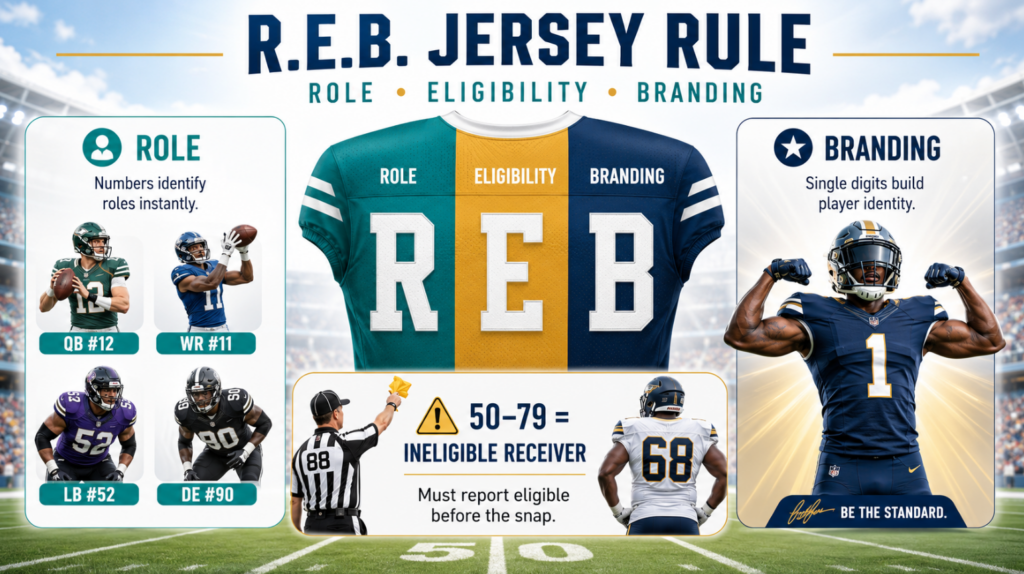
Role: Recognize who you are in a second
The most direct function of the number range is to tell the whole audience loudly what the player is doing. When the quarterback stands on the kickoff line and looks around, as long as he sees who is wearing a number 90 jersey, his mind will instantly react: “This guy is a defensive striker or linebacker, and he is going to rush over and kill me.” This visual classification can greatly speed up the pace of the game, allowing players and coaches to see the offensive and defensive substitutions on the field in just a few seconds.
Qualifying for catch (Eligibility): 50-79 rule of iron
One of the most deadly functions of the jersey number is to highlight the “eligibility to catch the ball” to the referee team “. Any player carrying 50 to 79 is undoubtedly doing the dirty work on the offensive front (center, guard and stop). The NFL rulebook says in black and white that people wearing this range number are never allowed to take forward passes. Suppose a player 68 takes a ball conveniently, unless he has already gone to the referee to “report” that he is a legal player before the kick-off, the referee will definitely throw the yellow flag in his face and blow an “illegal touch” without saying anything .

Personal Branding (Branding): The Carnival of Single-digit Numbers
After the relaxation of the rules in 2021, the jersey number has changed from a simple “practical tool” to the 1 “personal IP show”. The NFL has finally let go, allowing wide receivers, close-ends, running backs and defensive second-line players to wear numbers 1 to 9. This is the welfare that the players fought hard for. After all, single-digit jerseys look more handsome and neat to wear, and it also allows many stars to put on their signature robes in NCAA college days.
2023 NFL Official Jersey Number Interval Distribution
In addition to the offensive front, the league has expanded the optional numbers in almost all positions. If you want to recognize someone when watching football on weekends, you must follow the latest structure below.
| Position | Allowed Numbers (Updated 2023) | Notable Change |
|---|---|---|
| Quarterbacks (QB) | 0–19 | Now allowed to wear 0 |
| Running Backs (RB) | 0–49 | Gained single-digit numbers |
| Wide Receivers (WR) | 0–49, 80–89 | Gained single-digit numbers and 20–49 |
| Tight Ends (TE) | 0–49, 80–89 | Gained single-digit numbers and 20–49 |
| Offensive Line (OL) | 50–79 | No changes; strictly enforced |
| Defensive Line (DL) | 0–49, 90–99 | Gained 0–49 |
| Linebackers (LB) | 0–59, 90–99 | Gained 0–39 |
| Defensive Backs (DB) | 0–49 | Gained single-digit numbers |
Combat tactics: Why do quarterbacks hate the new rules?
The number expansion in 2021 has caused great tactical trouble to the veteran quarterbacks. Legendary quarterback Tom Brady (Tom Brady) has publicly shelled this change, and bluntly said it made the offense suffer a big loss. Before 2021, the quarterback can guess who is going to raid at a glance, because the linebacker can only wear more than 50 or 90 numbers, while the defensive second line wears more than 20, 30 or 40 numbers.
Now what? You might see a 240-pound bruiser linebacker in size 7 next to a 190-pound security guard in size 4. This “number camouflage” makes it difficult for quarterbacks and offensive fronts to quickly find out who “Mike” (middle linebacker) is in a very short countdown to the offense, making it extremely difficult to arrange blocking tactics after kickoff.
Pro’s Guide to Avoiding Pitfalls: Two Common Mistakes You Should Never Make When Buying Soccer Jerseys
Exposing the “Retro Timeline” Scam
Many people, unfamiliar with historical jersey-numbering conventions, easily end up purchasing counterfeit jerseys. It’s worth noting that, over the past few decades, the NFL has enforced strict rules regarding single-digit jersey numbers. If you happen to find a “vintage” jersey on the market claiming to belong to a defensive player from the 1990s or 2000s, only to discover it bears a single-digit number (for example, a Ray Lewis jersey with No. 5 instead of his iconic No. 52), there’s no doubt about it—it’s definitely a counterfeit. Pirated vendors often just grab a modern‑style roster template and slap it over old players’ names—those shoddy knockoffs are exposed in an instant.
Absolute dating assurance for “0”
If you buy a jersey with the number 0, it’s definitely a modern product. Before the 2023 season, the NFL absolutely prohibited anyone from wearing the number 0. Therefore, as long as a jersey bears the number “0” by itself, it’s clear that its wearer was active on the field in 2023 or later—players like Calvin Ridley or DeAndre Swift, for example. On authentic jerseys from before 2023, the number “0” would never appear on its own.
People Also Ask (FAQ)
What does a rugby shirt number mean to a striker?
As long as the number is between 50 and 79, it can be concluded that this buddy is an inside offensive front player. This specific number range directly locks in the rules the possibility of them running off the court to receive the front pass. This design is mainly designed to facilitate the referee to mark people. Once the boundary is crossed, it is easier to blow illegal pick-up players for fouls.
Can NFL players wear size 0?
Yes. Since the beginning of the 2023 season, NFL officials have released No. 0. Quarterbacks, running backs, wide receivers, tight ends, linebackers and defensive second-liners can now pick this number. However, whether it is an offensive front line or a defensive front line, it is still not allowed to touch No. 0.
Why are so many NFL players changing numbers now?
It’s also due to a rule change in 2021, which will finally allow players to switch back to the single-digit numbers they wore in Senior high school or college. People change their numbers just to create personal IP and make their surroundings sell better. Even if NFL stipulates that they have to buy all the jerseys of the old numbers out of their own pocket before changing their numbers, these people are willing.
What if a player changes positions midway through his career?
If the new position does not fall within the allowable range of his current number, he must change the number to comply. For example, if a defensive striker who used to wear No. 95 has switched to an offensive striker, he must honestly choose another one from No. 50 to No. 79.
Are the NCAA numbers rules the same as the NFL?
Completely different, the NCAA rules are much looser than the NFL. Historically, college players have been able to wear single digits in almost every position except the offensive front. What’s even more amazing is that the college team even allows two players on the same team to wear the same number, provided that they score on both ends of the offense and defense (one for offense and one for defense), and they must not appear on the court at the same time.