




How to Design Your Own Football Jersey: Create Custom Kits
Want to get your own football uniform? You have to choose the right polyester fabric that can wick sweat, adjust the CMYK color value strictly according to the textile printing standard, and send the team logo in vector format to professional sportswear manufacturers. Many amateur team captains don’t know how to do it, so they simply find a silly drag generator online to make do. The result? The printed Logo was full of mosaics, the clothes were thick and stuffy, and the sweat was all pasted on the body. I couldn’t even open the action when playing football.
In order to help you avoid these pits, we have summarized a set of extremely professional production process. Following this method, you can come up with a set of durable and style, comparable to the top professional clubs custom jerseys. Understand the fabric technology and file format of these doorways, can help you save a lot of money, will not destroy the whole team’s efforts.
C.A.P. Jersey Design Rules: A Professional Framework for Insiders
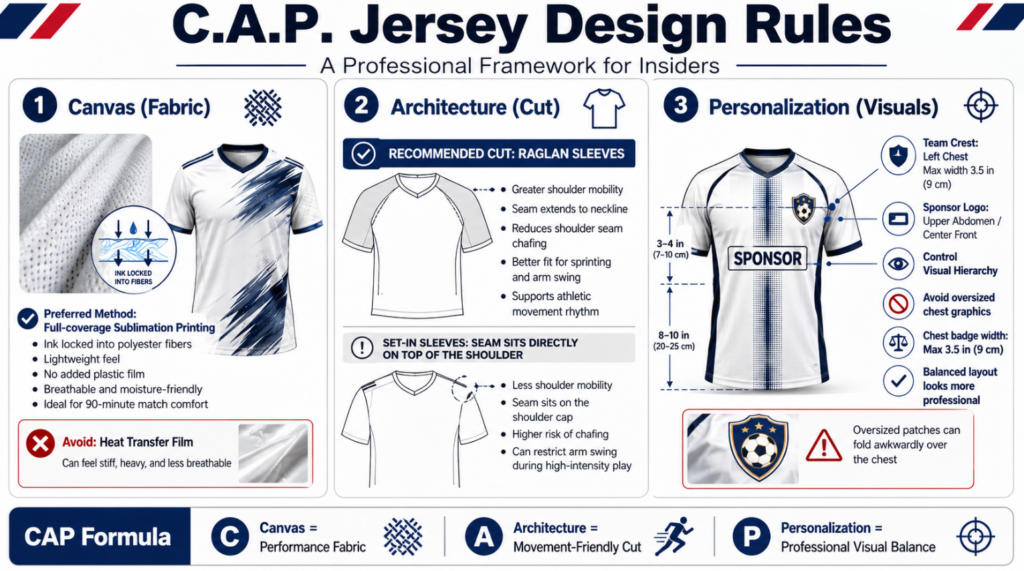
The so-called “C.A.P. rule” (canvas Canvas, architecture Architecture, personalized Personalization) is actually the core logic that determines the style and texture of the jersey. If you don’t even have a good fabric and cut, pick the color directly, and the final dress is definitely a semi-finished product. You know, those big-name sports manufacturers design jerseys strictly according to this basic logic before printing ink on fabrics.
Canvas (fabric): thermal sublimation process is always the first choice, do not use hot stamping
The full-width thermal sublimation process can directly “lock” the ink in the polyester fiber, not only the clothes will not become heavy, but also does not affect the air permeability at all. In contrast, the traditional hot stamping is to press a layer of plastic film on the surface of the clothes, which is hard and airtight, just like sticking a thermal insulation sticker on the body. When talking about production with manufacturers, be sure to kill the “sublimation printing” point, so as to ensure that your teammates stay dry during the 90-minute fierce battle.
Architecture (Tailoring): It is absolutely right to choose raglan sleeves.
Compared with ordinary set-in sleeves, raglan sleeves (Raglan sleeves) can make shoulders move more open. The seam of the ordinary sleeve is just stuck directly above the shoulder. As long as the player swings his arm greatly when sprinting, the seam will rub the skin crazily. If you choose raglan sleeves-that is, the kind of design where the sleeve fabric extends directly to the neckline-you can perfectly avoid this annoying seam and make the whole dress more suitable for the rhythm of the body during exercise.
Personalization (vision): to control the visual primary and secondary
If you want the jersey to look high-level, you must honestly abide by the visual typesetting rules: the team logo is placed on the left chest and the sponsor Logo is honestly located on the upper belly of China and India. Many non-professional “wild” designers especially like to exaggerate their team badges. As a result, those hard embroidery or printed patches are all folded on the pectoral muscles, which looks particularly awkward. According to a sentence, it is better not to exceed 3.5 inches (about 9 centimeters) in width on the chest, so that it looks professional enough.
Avoiding the ‘dirty color’ trap: the ultimate pre-production warning
Most of the time, you design on an ordinary laptop, and the screen displays RGB (red, green, blue) luminescence spectra. It will deceive your eyes and let you see the bright and blind fluorescent color, but the reality is that the printing machine can’t print this color on the fabric at all. Textile printing machine only recognize CMYK (green, magenta, yellow, black) ink mode. If you forget to convert RGB to CMYK before sending the design drawings to the factory, when you receive the clothes, you will find that the original bright green has turned into dirty dark green, and bright red has turned into dead dark red.

Therefore, before choosing the main color of the team, be sure to set the software you use (such as Adobe Illustrator or CorelDRAW) to CMYK mode. The most reliable way is to let the manufacturer give you a sample cloth of Pantone (PMS) entity color card. This is the only way to ensure that what you see on the screen is exactly the same color as the clothes you end up wearing.
Vector vs Bitmap: What format should the team logo and sponsor logo use?
| File Type | Format Examples | Print Result on Fabric |
|---|---|---|
| Vector File | SVG, AI, EPS, PDF | Crisp edges, clean details, and fully scalable without quality loss |
| Bitmap File | JPG, JPEG, PNG, BMP | May appear pixelated, blurry, or jagged when enlarged for printing |
Sportswear manufacturers usually ask you to provide vector files (such as SVG, EPS or AI format). Only in this way can the printed team logo and sponsor Logo edges be sharp and clear. Vector diagram uses mathematical formulas to calculate lines and shapes. No matter how large the factory enlarges it, it will not drop half a pixel.
If you throw a bitmap file (such as JPG or PNG) directly to the manufacturer, it is purely your own venue. Bitmaps are made up of countless colored squares (pixels). Imagine that when the factory hard-stretched your 500-pixel PNG picture to 12 inches wide and printed it on the chest, the small squares were infinitely enlarged, and the final effect was to 1 a blurry, mosaic-filled color block, which looked extremely fall in price. Before putting into production, be sure to spend money to find an art design to re-trace your hand-drawn pattern or bitmap into a clean vector diagram.
Take the data to speak: how strong is the sublimation process?
The sublimation printed jersey can retain 100% of the breathability of the fabric itself, because this process directly changes the color of the yarn, rather than pasting a layer of plastic on the top. We have done a comparative test with two identical 150-gram (GSM) polyester jerseys: 1 has a large area of hot-pressed and hot-pressed Logo printed on the chest, while the other 1 has a full-width sublimation printing.
After 45 minutes of intense exercise at about 30 degrees Celsius (85 degrees Fahrenheit), we found that the hot-stamped jersey contained 30 percent more water than the other 1. The huge plastic Logo blocked the evaporation channel of sweat to death, covering a “local sauna” on the players “. And what about the sublimation jersey? Sweat can be quickly drained evenly across the entire surface of the garment. This is enough to prove that in the fierce competitive sports, dyeing ink directly into clothes is definitely much more practical than ironing a sticker.
How to customize the size for the whole team?
If you want to make clothes for the whole team, you have to take care of all kinds of body types and make the sponsor Logo look harmonious whether it is printed on the adult men’s XL code or the juvenile m code. A 10-inch-wide Logo is just right for an adult, but if it is left intact on a child’s jersey, the word will have to go around his back and can’t even be seen.
Remember to instruct the manufacturers to open two different sets of printing molds: one for adults and one for children. In addition, the names, numbers and sizes of all players are integrated into a clean form and sent to the manufacturers, which can greatly avoid the risk of sending the wrong goods. Last but not least, force your team members to try on the physical sample clothes provided by this factory before placing an order! Don’t buy it blindly, because the floor size standards of different manufacturers are often far different.
Frequently Asked Questions (People Also Ask)
What kind of fabric is best for making custom football uniforms?
The 100% polyester mesh fabric with sweat-wicking black technology is definitely the first choice. This synthetic fabric does not absorb water, dries extremely fast, and is very high temperature resistant, which can perfectly resist the baking of the sublimation process without melting and deformation.
How much does it cost to design and print a custom football suit?
If the team orders in bulk, 1 high-quality sublimation custom jerseys will cost between $35 and $65. If you order your own piece, the price tends to soar to more than $80, because it includes high startup fees and a logistics premium for a small number of shipments.
Industry professionals generally use what software to do jersey design?
Professional sportswear designers basically use only Adobe Illustrator or CorelDRAW. These two vector software can make CMYK files that can be infinitely enlarged and directly used for typesetting and printing, and the factory can directly import them into industrial-grade thermal sublimation printers.
Can I print the logo of those famous brands on my custom jersey?
Don’t even think about it. Without a clear written business license, it is illegal to casually print someone else’s registered trademark (such as Nike, Adidas, or a real business sponsor). As long as it is a reliable printing factory, in order to avoid copyright lawsuits, such orders will definitely be rejected in seconds.
What is the difference between “player version (Authentic fit)” and “fan version (Replica fit)” in custom jerseys?
The player version uses a fabric with excellent elasticity and a tight waist design, featuring a body that fits tightly to the athlete. However, the fan version is often made of ordinary polyester that is not so elastic. The tailoring is relatively straight up and down, and the whole is loose and square. It is to take care of the body shape of most ordinary fans and is more restrained when worn at ordinary times.
Why is the color of the jersey I got different from what I saw on the screen?
Because your screen uses RGB light to display colors, and the factory uses CMYK ink to print clothes. If you don’t convert the design file into CMYK mode in advance, the printer will hard turn according to its default logic, and the final printed color will usually be dark or cause serious color difference.